Sometimes you just want a moment of calm. Maybe it’s sitting outside with your coffee. Maybe it’s taking a walk. Maybe it’s listening to music, reading a few pages of a book, or simply sitting quietly for a few minutes.
It doesn’t have to be anything complicated.
When life gets busy, we can get caught up in everything that comes along. We move from one thing to another without giving ourselves much time to stop and enjoy where we are.
🦋 The most productive thing you can do is slow down.
🦋 Take a moment.
🦋 Enjoy the moment.
🦋 Savor those moments of peace and calm.
You don’t always need to accomplish something during those moments. Sometimes you just might want to enjoy them.
And giving yourself that time isn’t selfish. It can be a simple way to create more calm and balance in your day.
You may have things waiting for you. There may always be another email, another task, or another thing on your list, but that doesn’t mean you can’t enjoy a few moments of calm.
Self-Reflection or Journal Question:
What is something simple that helps you slow down and enjoy a moment of peace and calm?
So instead of waiting for the perfect time to slow down, consider creating a little time for yourself along the way.
I would love to hear what works for you in the comments. 🦋
I know how easy it is to look at everything that needs to get done and feel like you need to keep going until it’s all finished.
🦋 The emails. 🦋 The work. 🦋 The errands. 🦋 The things at home. 🦋 The things you’ve been putting off.
But what if everything doesn’t actually need to get done today?
Sometimes creating more calm and balance starts with simply deciding what really needs my attention right now.
🦋 Choose what’s important.
🦋 Let some things wait.
🦋 And give yourself permission to pause.
Pausing doesn’t mean you’re giving up or falling behind. Sometimes a pause is exactly what we need to step away, clear our minds, and come back with a little more energy and a new perspective.
You don’t have to finish everything on your list to have had a productive day.
Maybe today, instead of asking yourself, “How am I going to get everything done?” ask yourself:
“What is the most important right now?”
Then give yourself permission to let the rest wait.
A Self-Reflection or Journal Question
What is one thing you could let wait today so you can create a little more calm for yourself?
I would love to hear from you in the comments. 🦋
A little reminder: You don’t have to do it all today. Choose what’s important. Let some things wait. Give yourself permission to pause. 🦋
Sometimes that pause gives us the time to think more clearly, reconnect with what truly matters. ~ Patti
Sometimes people come to me because they’re feeling stuck and aren’t sure what they want next.
Sometimes they’re trying to create more balance between work and life.
Sometimes they’re working through a career decision or growing into a leadership role.
And sometimes they simply need time to slow down and reset.
That’s what I do.
I’m a Leadership, Work-Life Balance, and Life Coach, and I’m also a Reiki Practitioner. I work one-on-one with people who want support as they move forward, reach their goals, create more balance, and build a life that feels purposeful and meaningful.
Coaching:
Coaching can be helpful when you’re navigating a career decision, working toward a personal goal, looking for more balance, or growing as a leader.
My coaching work includes:
Leadership coaching
Work-life balance coaching
Life coaching
Career and personal goal support
Reiki:
Reiki offers another way to slow down and reset.
Sometimes we simply need time to step away from the busyness of everyday life, relax, and give ourselves a chance to pause.
If you’re looking for support through coaching or would like to experience Reiki, you can book a session using my online booking link below.
Have you ever wondered what makes one coach different from another?
It’s a question I’ve thought about, too.
There are so many wonderful coaches, books, podcasts, and courses available today. I’m grateful that people have so many ways to learn and grow.
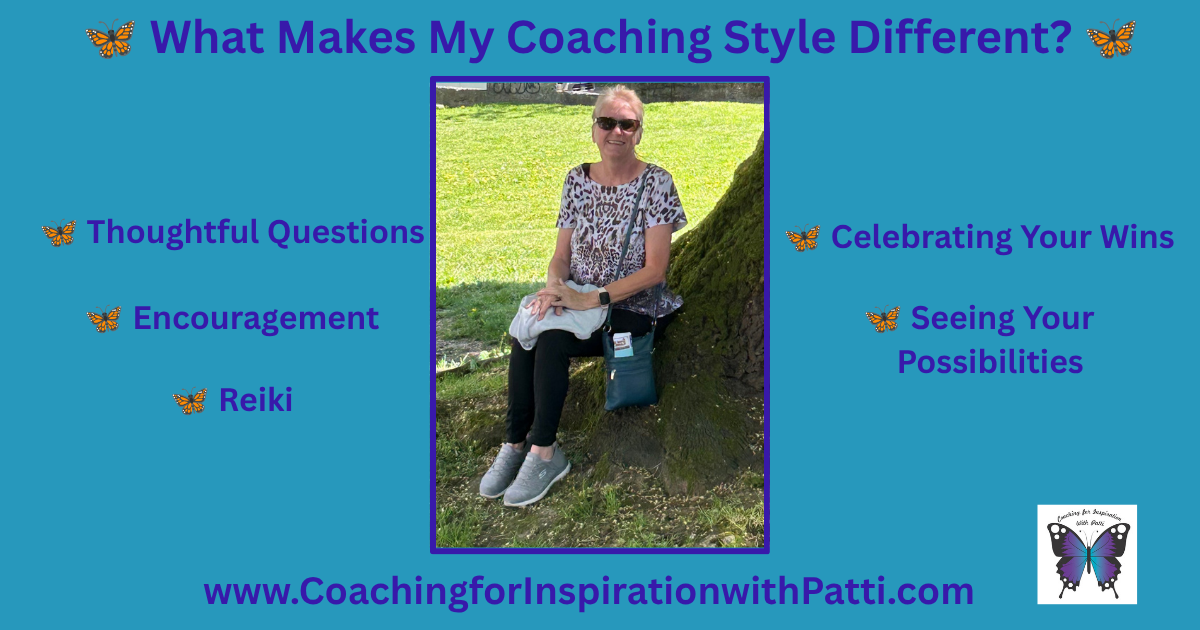
So what makes Coaching for Inspiration with Patti different?
For me, it’s not about having all the answers.
It’s about helping you discover the answers that are already within you.
I don’t believe you have to work harder or keep adding more to your to-do list to create the life you want.
I believe it starts by making time to reflect, becoming more aware of what’s truly important to you, and taking meaningful steps toward the life you want to live.
Whether we’re talking about leadership, work-life balance, relationships, your career, or simply the season of life you’re in, my role is to walk alongside you, not to tell you what to do.
🦋 I will ask thoughtful questions.
🦋 I will encourage you when you need it.
🦋 I will celebrate your wins with you.
🦋 I will help you see possibilities you may not have noticed on your own.
🦋 And if Reiki is part of your journey, I can support you there as well.
I hope that every conversation leaves you feeling encouraged, inspired, and more confident in everything you do.
🦋 I would love to hear from you.
When you’re looking for someone to support you, what qualities matter most?
To book your Life or Leadership Coaching session with me, go to https://www.vagaro.com/cfidfqf/services and scroll down to the Life or Leadership Coaching sections.
Have you ever reached the end of the day feeling exhausted, even though you didn’t do anything physically demanding?
It’s not because we’re doing too much physically. It’s because we’re carrying things that are draining us mentally and emotionally. What could you do to change this? Maybe take time to journal, meditate, or spend some time in prayer.
Four things that may lower your energy:
🦋 Saying yes when you really want to say no.
🦋 Replaying conversations or worrying about what might happen next.
🦋 Carrying others’ burdens that aren’t yours.
🦋 Taking on more tasks without finishing the tasks you already have.
Let’s Take A Pause:
Take a slow, deep breath and ask yourself:
• What am I feeling right now? • What’s been draining my energy?
Taking time for self-reflection helps you realize what you want, which creates more peace, calm, and balance.
🦋 Today’sAffirmation:
I let go of what doesn’t feel right to me for more calm, balance, and purpose.
🦋 Self-Reflection Question
What has been draining my energy?
I would love to hear from you in the comments. Which of these energy drains resonates with you the most?
Until next time, keep exploring life and work, creating more calm, more balance, and a life that’s meaningful to you. 🦋
To book your Life or Leadership Coaching session with me, go to https://www.vagaro.com/cfidfqf/services and scroll down to the Life or Leadership Coaching sections.
Have you ever walked away from a conversation only to replay it over and over in your mind?
Maybe you wished you had spoken up.
Maybe you wish you had stayed quiet and not reacted out of character.
Perhaps someone didn’t respond to your email or text, a coworker dismissed your idea or treated you unkind, a friend stopped calling, or someone never gave you the closure you wanted.
I have definitely been there. How about you?
As a coach, I often hear others say things like:
“I can’t stop thinking about what happened.”
“What if I said the wrong thing?”
“Why can’t I stop thinking about it?”
The truth is, overthinking conversations is something many of us experience. The good news is that we don’t have to stay stuck there.
Let’s explore why this happens, and how we can move toward peace and calm.
Why Do We Overthink Conversations?
When we replay conversations, we often believe we’re searching for answers.
In reality, we’re usually searching for something like resolution.
We want to understand.
We want closure.
We want reassurance that everything is okay.
Sometimes we receive those answers.
Sometimes we don’t.
Learning to live peacefully with unanswered questions is a great gift we can give ourselves.
One of the ideas I shared in this podcast episode is the difference between reflection and rumination.
Reflection sounds like:
What did I learn?
What would I do differently next time?
What boundary do I need?
Rumination sounds like:
Why did they do that?
Why don’t they care?
What if I had said something different?
Reflection helps us grow.
Rumination keeps us emotionally attached to a moment in time we can no longer change.
Whenever you notice yourself replaying a conversation, pause and ask yourself:
Am I learning something new, or am I simply reliving the same thoughts?
That one question can shift your entire perspective of the situation.
Not Every Conversation Needs a Solution
As coaches, we often encourage people to take action when action is needed.
But sometimes there isn’t going to be another conversation.
There isn’t an apology coming.
There isn’t an explanation.
And that’s a hard thing to accept.
I’ve learned that peace doesn’t always come from receiving closure.
Sometimes peace comes from deciding that I no longer need the conversation to continue inside my mind.
That doesn’t mean what happened didn’t matter.
It means I choose not to let it continue stealing my peace and joy.
The Power of Healthy Boundaries:
Many caring people struggle with overthinking (me included) 🙂 because we care too deeply about others.
We want people to feel heard.
We want relationships to work.
We want everyone to be okay.
But here’s something I’ve learned through coaching:
You are not responsible for carrying every relationship by yourself.
Healthy relationships involve mutual respect, communication, and effort.
Healthy boundaries remind us that we can care deeply without carrying everything and everyone. It takes effort and practice to stop the habit and behavior.
A Reiki Priniciple:
As a Reiki Master Practitioner, one of my favorite Reiki Principles is:
Just for today, I will not worry.
I love this principle because it gently reminds us to return to the present moment.
Many of our worries involve things we simply cannot control:
What someone else meant.
Whether someone approves of us.
Whether they’ll ever respond.
Whether we’ll ever receive closure or an explanation.
When I notice my thoughts beginning to loop, I often pause, take a slow breath, place my hands over my heart, and repeat:
Just for today, I will not worry.
It helps me reconnect with the present moment instead of becoming lost in that previous conversation.
Practical Coaching Tips to Stop Overthinking:
Here are a few strategies I often share with coaching clients:
Separate Facts from Assumptions:
Ask yourself:
What do I know to be true?
What story am I creating?
Decide if Action Is Needed
Do I need to apologize?
Do I need clarification?
Do I need another conversation?
If yes, take action.
If no, practice letting it go.
Give Yourself a Reflection Time Limit:
Spend a few minutes reflecting.
Learn the lesson.
Then choose to move forward.
Return to the Present Moment:
Take a walk.
Recite a Reiki Principle.
Journal.
Breathe deeply.
Repeat an affirmation.
Your peace lives in the present, not in replaying the past.
Journal Prompts
Spend a few quiet moments reflecting on these questions:
What conversation am I still carrying?
What lesson is this experience teaching me?
What assumptions might I be making?
Is there any action I truly need to take?
What healthy boundary would create more peace?
If I stopped replaying this conversation today, what would become possible for me?
This Week’s Affirmation
I can learn from my experiences without reliving them.
Repeat it whenever you notice your thoughts beginning to spiral.
Final Thoughts
One of the greatest lessons I’ve learned is that peace isn’t found by replaying the same conversation one more time. Peace comes from trusting ourselves. Trusting that we did the best we could with what we knew at the time. Trusting that every experience has something to teach us. And trusting that we can move forward, even without all the answers.
Thank you for reading this blog post, or watching the video or listening to the podcast episode. I hope this message encourages you to be gentle with yourself and reminds you that growth is not about perfection, it’s about learning, healing, and moving forward one step at a time.
Many caring people find themselves carrying more than their share of emotional weight.
You want to help. You want to be supportive. You want the people you care about to feel better. But along the way, you may begin to absorb their stress, anxiety, frustration, or overwhelm as if it were your own.
This can happen in relationships, with your partner, in friendships, families, and even in the workplace.
Before you know it, you’re emotionally exhausted.
For example, someone shared a challenge they were facing. Your spouse is stressed, a coworker is frustrated, a family member is overwhelmed, or a friend needs support.
Hours later, you realize you’re still carrying the weight of that conversation and rethinking it over and over.
Many caring, compassionate people unintentionally absorb others’ emotions. While empathy is a beautiful gift, carrying everyone else’s emotional load can leave us drained, overwhelmed, stressed, exhausted, and disconnected from ourselves.
There is a difference between supporting someone and carrying others’ emotions.
Supporting someone allows us to:
Listen with compassion
Offer encouragement
Be present
Carrying someone else’s emotions often looks like:
Worrying about them long after the conversation ends
Feeling responsible for solving their problems
Absorbing their stress as if it were your own
Feeling emotionally exhausted afterward
Self-Reflection Questions to Ask Yourself:
The next time you feel emotionally overwhelmed after a conversation, pause and ask:
What emotions belong to me?
What emotions belong to the other person?
What do I need right now to feel grounded?
Am I supporting or am I carrying the emotions of others?
These questions can create awareness and help you reconnect with yourself.
The strongest relationships are not built by carrying everything for one another. They are built through connection, communication, respect, and emotional awareness.
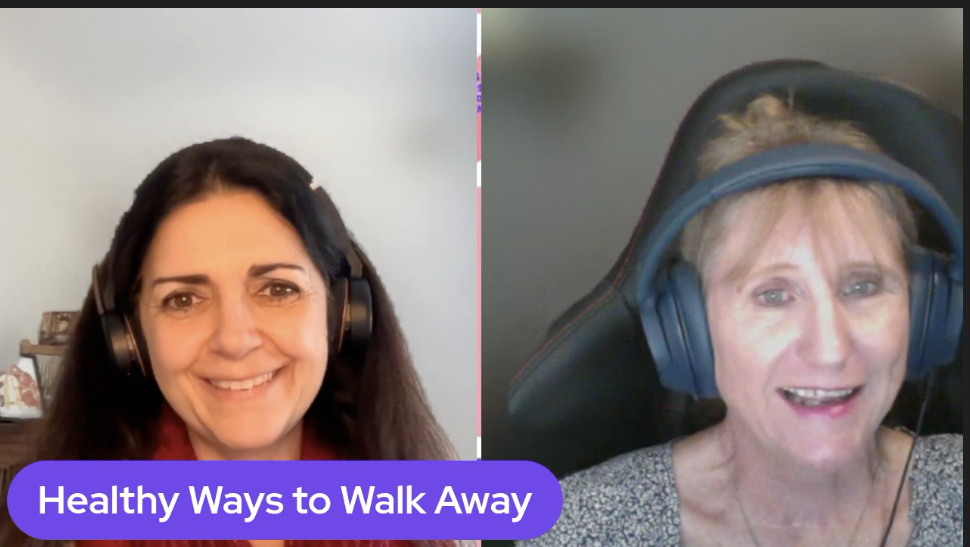
In this episode of Building Better Relationships at Home and Work with Angela and Patti, we explore the emotional load—the invisible responsibility of managing thoughts, feelings, and expectations for others.
You may recognize it in the way you replay conversations, anticipate needs, or try to keep everything running smoothly.
This conversation gently invites you to notice what you’re carrying—and consider what you may be ready to release.
Key Takeaways
• Emotional load is often invisible—but deeply felt • Holding what’s unsaid creates mental and emotional strain • Letting go doesn’t mean you stop caring • Awareness is the first step toward change
Reflection
What have I been holding that may not be mine?
Affirmation
I am allowed to release what is not mine to carry.
If this episode spoke to you, share it with someone who may be carrying too much too.
In this Building Better Relationships at Home and Work with Angela and Patti Podcast in Episode 95, we explore the difference between helping and over-functioning and how to support others without taking over.
At work, that might look like finishing a task for someone because it feels faster. At home, it might mean solving a problem for someone you love to make things easier for them.
Most of us genuinely want to be supportive. We want to help the people we care about. We want to make things easier for our team, our family, or our friends. And often we step in because we see a problem and we know we can fix it.
But sometimes support can quietly turn into something else.
It can turn into carrying more than our share. It can turn into stepping in too quickly. And sometimes, without meaning to, it can even prevent someone else from growing.
As you think about support in your own life, you might reflect on a few questions:
• When do I tend to step in quickly to help? • What signals show up in my body when I feel responsible for solving something? • What might change if I paused and asked what kind of support is actually needed?
These small moments of awareness can help us create support that builds confidence rather than dependency.
Sometimes, a thoughtful conversation and a fresh perspective can open the door to meaningful change.
Thanks for listening to or watching this video. Please like, comment, share, and subscribe. 🙂
Disclaimer: This podcast and blog content are for educational and reflective purposes and not intended to replace professional medical, psychological, legal, or financial advice.
Many people fear a fallout, the emotional reaction, backlash, or relationship tension that may follow honest communication.
In this episode, Angela and Patti explore how to find your voice even when that fear rises.
What Is a Fallout?
A fallout is the emotional or relational aftermath when communication leads to:
Hurt feelings
Misunderstanding
Anger or withdrawal
Blame or retaliation
Changes in trust or connection
Avoiding hard conversations can create resentment and emotional distance.
Silence can feel like the safest option until it starts to hurt.
The best way to prevent a fallout is to communicate early and with empathy.
By learning to communicate early, set boundaries, and resolve concerns with confidence before resentment and conflict build, this can help prevent fallout.
Reflection Question:
What small conversation have I been avoiding that would help prevent bigger conflicts later?